CSU hosts PASM 2026 Summer School on symmetry and modern magnetism

Original post

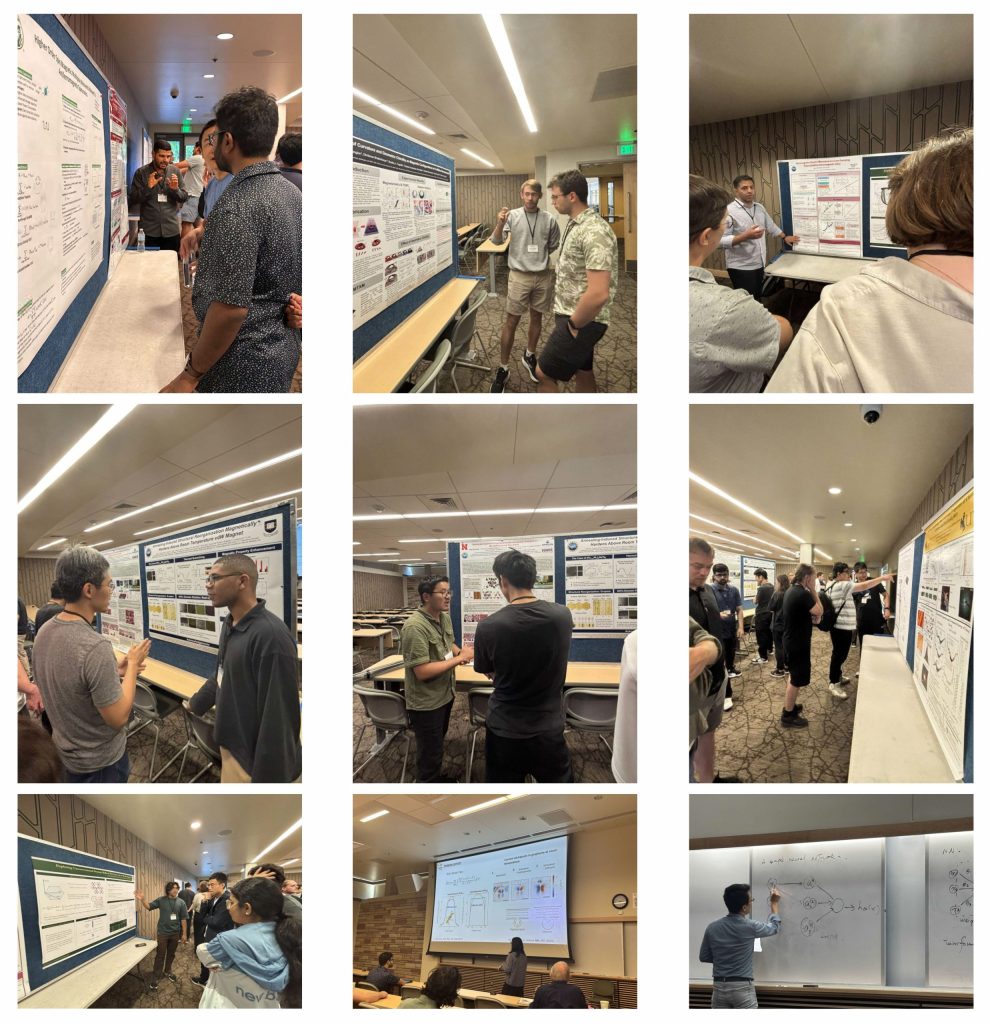
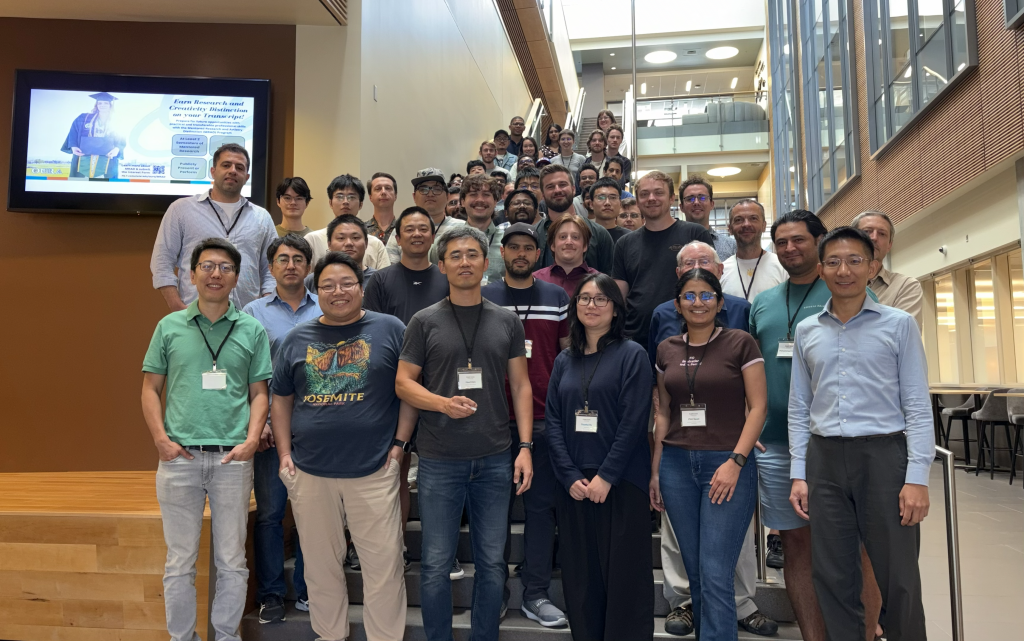
Colorado State University hosted more than 50 students, postdoctoral researchers, faculty members and scientists July 13-17 for the 2026 Principles and Applications of Symmetry in Magnetism (PASM) Summer School. Held in the Scott Bioengineering Building on CSU’s Fort Collins campus, the five-day program combined advanced instruction with sustained opportunities for discussion and collaboration.

Supported by the National Science Foundation and CSU Physics Department, PASM 2026 was designed to introduce early-career researchers to modern spin-related physics while connecting people working across theory, computation and experiment. Participants came from universities and national laboratories in the United States and abroad.

Symmetry served as the unifying language for a program spanning antiferromagnetic dynamics, quantum sensing, electron correlations, topological transport, unconventional magnetism, quantum geometry and artificial intelligence-assisted materials research. The school emphasized the conceptual relationships among them and their relevance to emerging magnetic and quantum technologies.

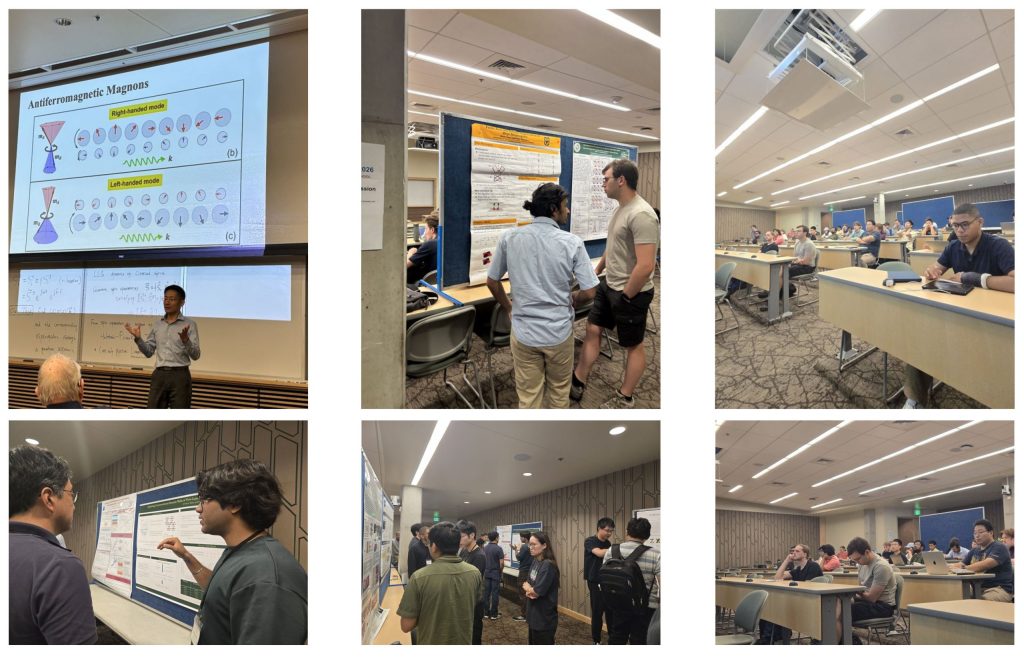
Seven invited lecturers led multi-part courses during the week: Ran Cheng of UC Riverside on antiferromagnetic dynamics; Chunhui Du of Georgia Tech on quantum sensing of quantum materials; Satoshi Okamoto of ORNL on electron correlations and Hall effects; Yaroslav Tserkovnyak of UCLA on symmetry-enabled topological transport and entanglement generation; Binghai Yan of Penn State on unconventional magnetism and quantum geometry; Gen Yin of Georgetown University on computational quantum geometry; and Qimin Yan of Northeastern University on symmetry and artificial intelligence. The schedule reserved time each day for questions and broader discussion, allowing ideas introduced in one lecture series to carry into the others.

The program also featured 24 participant presentations organized into three thematic poster sessions. The sessions covered magnetic textures, dynamics and imaging; spin transport, torques and devices; and altermagnets, topology, quantum geometry and materials design. For many participants, the posters provided a first opportunity to discuss developing research directly with junior and senior researchers in closely related fields outside their home institutions.

The combination of lectures, posters and informal conversations was central to the school’s purpose. It gave graduate students and postdoctoral researchers a setting in which to ask detailed questions, compare theoretical and experimental perspectives, and build connections with peers working on related problems.

PASM 2026 was organized by Hua Chen, associate professor of physics at CSU and chair of the organizing committee; Ran Cheng of UC Riverside; and Qimin Yan of Northeastern University. CSU physics graduate students Reaz Bhuiyan, Sparsh Ghimire, Achintya Mitra, and Afsana Sharmin assisted with on-site organization and participant logistics. The organizers also gratefully acknowledge Theo Kanbe and Krysta Loeser for their essential administrative and logistical support.

Selected lecture materials, the complete program and additional photographs are available on the PASM 2026 website:
https://magnetics.colostate.edu/pasm2026/s are available on the PASM 2026 website: 2026 Principles and Applications of Symmetry in Magnetism Summer School – Center for Advanced Magnetics | CSU
Seeing Hidden Order in Kagome Spin Ice

Frustrated magnets are fascinating partly because they often refuse to order in the usual way. In kagome spin ice, the magnetic moments are constrained by a local “ice rule”, which produces many nearly equivalent spin configurations and makes conventional magnetic order difficult to establish, as well as to characterize. This becomes especially subtle when the ordered state breaks time-reversal symmetry but carries no net magnetization.

In a recent collaboration [1], we studied this problem in the kagome spin-ice compound HoAgGe. Using neutron scattering, thermodynamic measurements, and Monte Carlo simulations, we found that HoAgGe orders through a three-dimensional XY transition. This is an interesting and previously unexplored ordering pathway for quasi-two-dimensional kagome spin ice realized in an actual crystal.

A key message of the work is that nonlinear susceptibility can reveal hidden time-reversal-symmetry breaking even when there is no macroscopic magnetic moment. In HoAgGe, the two time-reversal-related ground states cannot be easily distinguished by linear magnetic response, but they respond differently at nonlinear order. Microscopically, this behavior is tied to ice-rule-compatible one-spin-flip excitations, suggesting that the effect is not a peculiarity of HoAgGe but a more general property of kagome spin ice with the same type of ground state.

We hope this work helps establish nonlinear magnetic susceptibility as a useful probe of hidden magnetic order in frustrated magnets. More broadly, it shows that real kagome spin-ice materials can host ordering phenomena that are richer than those captured by idealized two-dimensional models, and may continue to inspire new theoretical and experimental developments in frustrated magnetism.

[1] K. Zhao, H. Deng, H. Chen, N. Ma, N. Oefele, J. Guo, X. Cui, C. Tang, M. J. Gutmann, T. Mueller, Y. Su, V. Hutanu, C. Jin, and P. Gegenwart, “Three-Dimensional XY Universality and Nonlinear Magnetic Susceptibility in a Kagome Ice Compound”, Physical Review X 16, 021043 (2026).

Congratulations to Luke for passing his PhD defense!

Luke’s work: A new kind of Hall effect: Physicists reveal potential of noncollinear antiferromagnets in spintronics

Congratulations to Christopher for passing his PhD defense!

Related post on Christopher’s work: When Hall Signals Mislead

When Hall Signals Mislead

Hall measurements have long been a workhorse in condensed matter physics, offering a simple yet powerful way to probe electronic properties of materials. But as experiments increasingly venture into systems with mesoscopic spatial inhomogeneities, including, e.g., composition, magnetic domains, strain, and various moiré patterns, the interpretation of Hall measurements becomes less straightforward. A common assumption is that the measured Hall response from an inhomogeneous sample simply reflects an average of local Hall effects. But in reality, this is not always justified. Charge signals detected at the sample boundary are governed by global current paths and field distributions, which are shaped by the full spatial profile of the sample, not just its average properties.

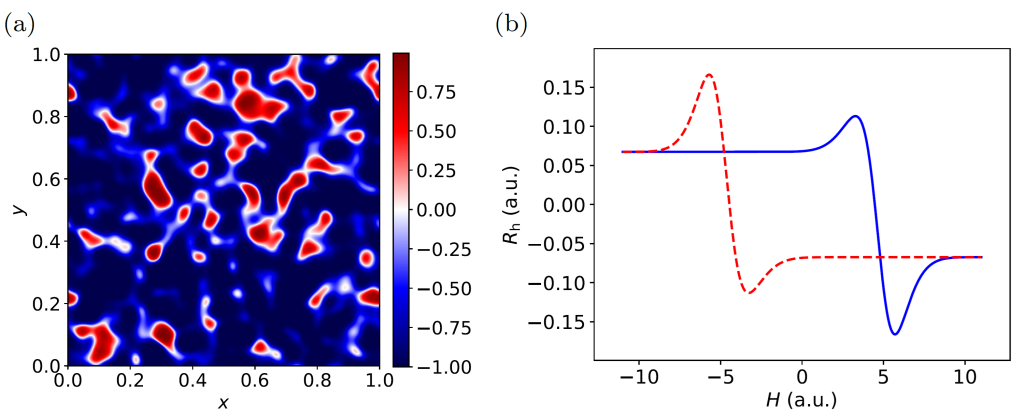
In a recent collaboration between physicists and mathematicians [1], we rigorously address this issue by deriving exact mathematical bounds on the global anomalous Hall conductivity (AHC) of inhomogeneous systems. Specifically, we prove that the measured Hall response must lie between the maximum and minimum values of the local anomalous Hall conductivity across the sample. This seemingly simple result provides a powerful diagnostic tool: Any apparent deviation of the measured signal outside this range can only arise from one of two possibilities—either the assumed local bounds are incorrect, or the measured quantity is not the true global anomalous Hall conductivity. Importantly, our framework allows for a clear classification of the often-debated Hall “hump” features (Figure below) observed during magnetic reversal in certain systems, distinguishing whether they originate from real topological effects (like skyrmions) or from magnetic and structral inhomogeneities.

We hope this work will serve as a robust anchor for interpreting future anomalous Hall experiments and perhaps inspire new ways of designing transport probes in magnetic materials.

[1] Christopher Ard, Evan Camrud, Olivier Pinaud & Hua Chen, “Bounds and anomalies of inhomogeneous anomalous Hall effects”, Communications Physics 8, 209 (2025).

Congratulations to Aidan for passing his PhD defense!

Aidan Winblad at his PhD defense on March 14, 2025.

Related post on Aidan’s work: Triangulating Majorana fermions

Physicists Uncover “Hall Mass” Driving Spin Currents Sideways in Advanced Magnets

A team of researchers led by Colorado State University graduate student Luke Wernert and Associate Professor Hua Chen has discovered a new kind of “Hall effect” that could enable more energy-efficient electronic devices. Their findings, published in Physical Review Letters in collaboration with graduate student Bastián Pradenas and Professor Oleg Tchernyshyov at Johns Hopkins University, reveal a previously unknown “Hall mass” in complex magnets called noncollinear antiferromagnets.  

The Hall effect—first discovered by Edwin Hall at Johns Hopkins in 1879—usually refers to electric current flowing sideways when exposed to an external magnetic field, creating a measurable voltage. This sideways flow underpins everything from vehicle speed sensors to phone motion detectors. But in the CSU team’s work, electrons’ spin (a tiny, intrinsic form of angular momentum) takes center stage instead of electric charge. Noncollinear antiferromagnets, unlike more familiar magnets where spins line up parallel or antiparallel, have spins oriented in different directions but still sum to zero net magnetization. This unique spin texture enables a fresh take on the Hall effect, where spin currents can flow at right angles rather than just electric charges. 

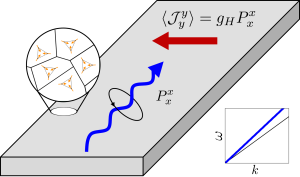
 “Imagine pushing a spin current in one direction and getting a second spin current going sideways,” Wernert explains. “That’s the hallmark of a Hall effect.” The reason this new effect—governed by the “Hall mass”—appears only in noncollinear antiferromagnets is because they have three degrees of freedom describing spin orientations. This extra complexity leads to three branches of spin waves (collective vibrations of the spins), two of which naturally flow sideways in response to a driving force. Experimentally, researchers can measure this Hall mass either by injecting spin waves from a conventional ferromagnet into a noncollinear antiferromagnet and detecting spin accumulation along the edges, or by using scattering techniques (like neutron or x-ray) to track the low-energy spin-wave spectrum. 

A scientific diagram of the Wernert and Chen Hall Mass effect.

Because spin currents produce far less heat than electrical currents, harnessing them could revolutionize modern electronics. This prospect underlies the rapidly growing field of “spintronics,” which strives to build devices—such as magnetic-based storage (Magnetoresistive Random-Access Memory, MRAM)—that are more energy efficient and resistant to data corruption by external magnetic fields. In conventional magnetic materials, a stray magnetic field can sometimes wipe out stored information; by contrast, noncollinear antiferromagnets are much less susceptible to such interference, making them potentially safer for data storage and handling. Altogether, the discovery of this new Hall effect and its associated Hall mass opens an exciting direction in condensed matter physics and could guide the development of next-generation technology powered by spin. 

Luke Wernert, Bastián Pradenas, Oleg Tchernyshyov, and Hua Chen, “Hall mass and transverse Noether spin currents in noncollinear antiferromagnets”, arXiv:2404.12898, Phys. Rev. Lett. 134, 016706 (2025).

Phys.org: A new kind of Hall effect: Physicists reveal potential of noncollinear antiferromagnets in spintronics

CSU Source: Physics researchers discover new Hall Effect, making way for more energy-efficient technology

Triangulating Majorana fermions

Braiding two MZM in a Kitaev triangle. Adapted from [1].

Topological quantum computation (TQC) based on Majorana zero modes (MZM) has been actively pursued in the past decade. Aside from well-recognized challenges in unambiguously identifying MZM in existing effective one-dimensional p-wave superconductors, the next step of demonstrating braiding of MZM is even more formidable. The most prevalent proposal on realizing braiding operation is based on networks of effective p-wave superconductor wires subject to many tiny electric gates that are distributed along the wires and can be sequentially turned on or off, so that the MZM can be adiabatically moved across different parts of the network. It is then a natural question to ask if there exists an alternative, possibly more practical architecture for braiding MZM, that may even be more friendly to near-term MZM systems.

Motivated by this question, as well as the recent experimental breakthrough on demonstrating MZM in a minimal Kitaev chain consisting of only two quantum dots [Dvir et al., Nature 614, 445 (2023)], we propose in [1] a couple of new structures for braiding MZM based on triangular superconducting islands that can either be constructed in a bottom-up manner as a minimal extension of the two-site Kitaev chain, or appear naturally in epitaxial growth of ultrathin films. For the former case, we have shown that a minimal 3-site “Kitaev triangle” can host MZM at different pairs of vertices that can be controlled by a non-uniform vector potential. We have demonstrated braiding two MZM in this minimal model by explicitly calculating the many-body Berry phase. For the latter case, we have extended the 3-site Kitaev triangle to a finite-size triangular island with a hollow interior. We have shown that using a uniform vector potential, one can induce a pair of MZM at different pairs of vertices of the triangle. Moreover, rotating the uniform vector potential can change the positions of the MZM without closing the bulk band gap, i.e., adiabatically. Finally we have given a scalable design, backed by numerical calculations, for braiding two out of four MZM that corresponds to nontrivial logical gate operations, in a network of corner-sharing hollow triangles.

Our work provides a novel platform in parallel with the coupled-wire network design for braiding MZM, and is practical especially considering near-term MZM devices. The Kitaev triangle offers an alternative strategy towards MZM-based TQC that is not based on bulk-boundary correspondence, which may be easier to realize in near-term quantum-dot=based devices than coupled wires. On the other hand, our proposal of a uniform vector potential coupled to hollow triangles explores the utility of geometry rather than the individual control of superconducting nanowires. It highlights that triangles, as a geometry, are unique compared to other quasi-2D structures such as wires, squares, or circles, since they naturally break 2D inversion symmetry and do not present a straightforward strategy for morphing into either 1D or 2D structures with periodic boundary conditions.

[1] Aidan Winblad and Hua Chen, Superconducting triangular islands as a platform for manipulating Majorana zero modes, Physical Review B 109, 205158 (2024).

Tunneling current-controlled spin states in few-layer van der Waals magnets

The phenomenon of spin-transfer torque in bilayer metallic ferromagnets is well understood in terms of Landau-Lifshitz equation modified by magnetic torques carried by electric currents. However, when each ferromagnet layer is replaced by a single atomic layer of vdW magnetic insulators and electric transport through the bilayer is highly coherent, is the above picture still applicable? In a recent collaborative work [1], we argued that switching between layer-resolved collinear antiferromagnetic and ferromagnetic states in bilayer insulating CrI3 is achieved by tunneling-current-induced spin accumulation of opposite signs at metallic electrodes in contact with the respective CrI3 monolayers, which from a symmetry point of view is a general mechanism for switching between uniform and nonuniform magnetic states. A pedagogical news article summarizing the main findings of the work can be found here.

[1] ZhuangEn Fu, Piumi I. Samarawickrama, John Ackerman, Yanglin Zhu, Zhiqiang Mao, Kenji Watanabe, Takashi Taniguchi, Wenyong Wang, Yuri Dahnovsky, Mingzhong Wu, TeYu Chien, Jinke Tang, Allan H. MacDonald, Hua Chen* & Jifa Tian*, “Tunneling current-controlled spin states in few-layer van der Waals magnets”, Nature Communications 15, 3630 (2024).

Quantum interference in density wave systems

When hearing “pi-phase” and “quantum oscillations”, would you immediately jump to Berry phase? In a recent collaborative work, we have shown that a new kind of “pi-phase shift”, i.e., that between quantum oscillations in longitudinal resistivities along orthogonal directions, in the prototypical spin density wave material Cr, is caused by quantum interference effects between coupled semiclassical orbits. For an in-depth introduction, see this note which was a presentation given at the “Magneticians’ meeting” at Johns Hopkins University in 2023.

Y. Feng, Y. Wang, T. F. Rosenbaum, P. B. Littlewood, and H. Chen, “Quantum interference in superposed lattices”, Proc. Natl. Acad. Sci. 121, e2315787121 (2024).