
Hua Chen
Author's posts
Sep 09
CSU hosts PASM 2026 Summer School on symmetry and modern magnetism
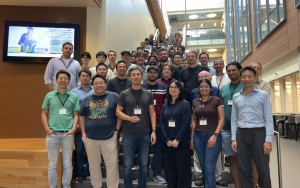
Original post Colorado State University hosted more than 50 students, postdoctoral researchers, faculty members and scientists July 13-17 for the 2026 Principles and Applications of Symmetry in Magnetism (PASM) Summer School. Held in the Scott Bioengineering Building on CSU’s Fort Collins campus, the five-day program combined advanced instruction with sustained opportunities for discussion and collaboration. …
Jun 10
Seeing Hidden Order in Kagome Spin Ice

Frustrated magnets are fascinating partly because they often refuse to order in the usual way. In kagome spin ice, the magnetic moments are constrained by a local “ice rule”, which produces many nearly equivalent spin configurations and makes conventional magnetic order difficult to establish, as well as to characterize. This becomes especially subtle when the …
Apr 01
Congratulations to Luke for passing his PhD defense!
Luke’s work: A new kind of Hall effect: Physicists reveal potential of noncollinear antiferromagnets in spintronics
Aug 19
Congratulations to Christopher for passing his PhD defense!
Related post on Christopher’s work: When Hall Signals Mislead
May 27
When Hall Signals Mislead
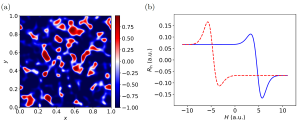
Hall measurements have long been a workhorse in condensed matter physics, offering a simple yet powerful way to probe electronic properties of materials. But as experiments increasingly venture into systems with mesoscopic spatial inhomogeneities, including, e.g., composition, magnetic domains, strain, and various moiré patterns, the interpretation of Hall measurements becomes less straightforward. A common assumption is …
Mar 25
Congratulations to Aidan for passing his PhD defense!
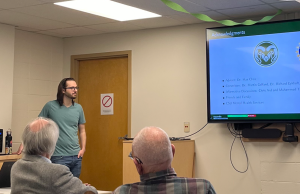
Aidan Winblad at his PhD defense on March 14, 2025. Related post on Aidan’s work: Triangulating Majorana fermions
Mar 12
Physicists Uncover “Hall Mass” Driving Spin Currents Sideways in Advanced Magnets
A team of researchers led by Colorado State University graduate student Luke Wernert and Associate Professor Hua Chen has discovered a new kind of “Hall effect” that could enable more energy-efficient electronic devices. Their findings, published in Physical Review Letters in collaboration with graduate student Bastián Pradenas and Professor Oleg Tchernyshyov at Johns Hopkins University, reveal a …
Jun 19
Triangulating Majorana fermions
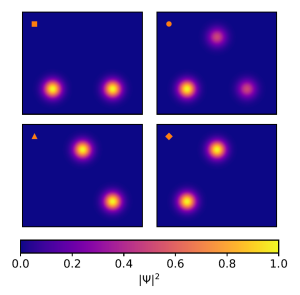
Topological quantum computation (TQC) based on Majorana zero modes (MZM) has been actively pursued in the past decade. Aside from well-recognized challenges in unambiguously identifying MZM in existing effective one-dimensional p-wave superconductors, the next step of demonstrating braiding of MZM is even more formidable. The most prevalent proposal on realizing braiding operation is based on …
May 03
Tunneling current-controlled spin states in few-layer van der Waals magnets
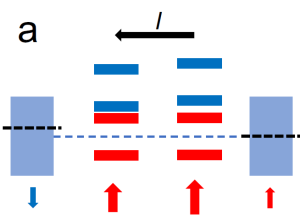
The phenomenon of spin-transfer torque in bilayer metallic ferromagnets is well understood in terms of Landau-Lifshitz equation modified by magnetic torques carried by electric currents. However, when each ferromagnet layer is replaced by a single atomic layer of vdW magnetic insulators and electric transport through the bilayer is highly coherent, is the above picture still …
Feb 07
Quantum interference in density wave systems
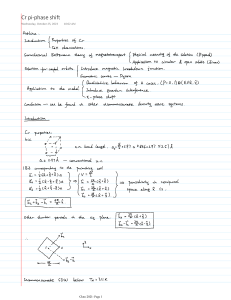
When hearing “pi-phase” and “quantum oscillations”, would you immediately jump to Berry phase? In a recent collaborative work, we have shown that a new kind of “pi-phase shift”, i.e., that between quantum oscillations in longitudinal resistivities along orthogonal directions, in the prototypical spin density wave material Cr, is caused by quantum interference effects between coupled …
- 1
- 2
Recent Comments